- Cyber Resilience
- ·
- Nov 16, 2026
Expect the Breach: Why Cyber Resilience Matters More Than Ever
By AgilenLite
We're a small company. Who would bother hacking us?”
I hear some version of this almost every month, usually from a business owner who has just installed antivirus and feels the job is done. I understand the feeling. Cyber incidents sound like something that happens to banks and big tech firms.
The last two weeks in Singapore tell a different story.
A Fortnight Of Breaches
Between late October and today, organisations of every type and size have told the public that someone got into their systems. Here is a plain-language roundup:
M1 (telco): found a breach on 30 October and announced it on 6 November. Customer names, NRIC/FIN numbers, dates of birth, mobile numbers, emails and home addresses were affected. No card or banking details were taken.
Fullerton Health (healthcare): became aware on 31 October that a server supporting its Migrant Worker Primary Care Plan had been accessed. Workers' names, FIN numbers, dates of birth, contact details and addresses were affected. No medical or financial data was involved.
Dementia Singapore (charity): its CARA app was hit on 1 November. The organisation only noticed because unauthorised notifications were sent to members. Names, emails, phone numbers and membership IDs may have been exposed. Its third-party app provider moved to contain the incident.
SPH Media (media group): five of its systems were attacked between 4 and 8 November, affecting about 9% of its database, mostly email addresses. It suspects the attacks were AI-enabled and said software bugs and system configuration played a part.
Agency for Integrated Care (public sector): detected unauthorised access to its Advance Care Planning system on 10 November. Names, contact numbers, emails and NRIC numbers of up to 4,064 healthcare and community care staff may have been accessed.
Our Second Nature (local fashion label): discovered on 6 November that someone had broken into its backend sales records. Customer names, emails, phone numbers, birthdays, delivery addresses and purchase details may have been exposed. Card details were safe because the company never stored them.
On 12 November, the Ministry of Health issued a statement noting that six healthcare and healthcare-related organisations had recently reported incidents, and reminded providers to strengthen their defences.
A telco, clinics, a charity, a newsroom and a clothing brand. If there is a pattern, it is that nobody is too small or too unusual to be a target.
Then The Emails Stopped
On Nov 13, 2026, many of us opened our laptops and found Outlook and Teams not loading. Microsoft 365 was disrupted for more than five hours worldwide. In Singapore the trouble started just after midnight, and local outage reports peaked at around 9.30am, right as the working day began.
This one had nothing to do with hackers. Microsoft explained that a number of its servers had unexpectedly gone offline, and the remaining ones could not carry the load.
I found it a useful reminder. A breach and an outage have different causes, but for your customers the experience can feel the same: the service they rely on suddenly isn't there.
What This Means For Your Business
Prevention still matters. Patching systems, using strong passwords and two-factor authentication, and vetting your vendors all reduce the odds of an incident.
But no control is perfect. Several of the incidents above involved third-party providers or simple configuration gaps, and an outage at a global provider is entirely outside your control. So, the more useful question is this: when something goes wrong, can we keep serving our customers, and can we recover quickly?
That is what cyber resilience means. It is the ability to keep going, and to bounce back, after a breach or disruption.
Here is how AIC responded to its incident: when its care planning system was taken offline as a precaution, facilitators switched to physical forms and carried on. The system was restored two days later. Nothing high-tech, just a fallback that people knew how to use.
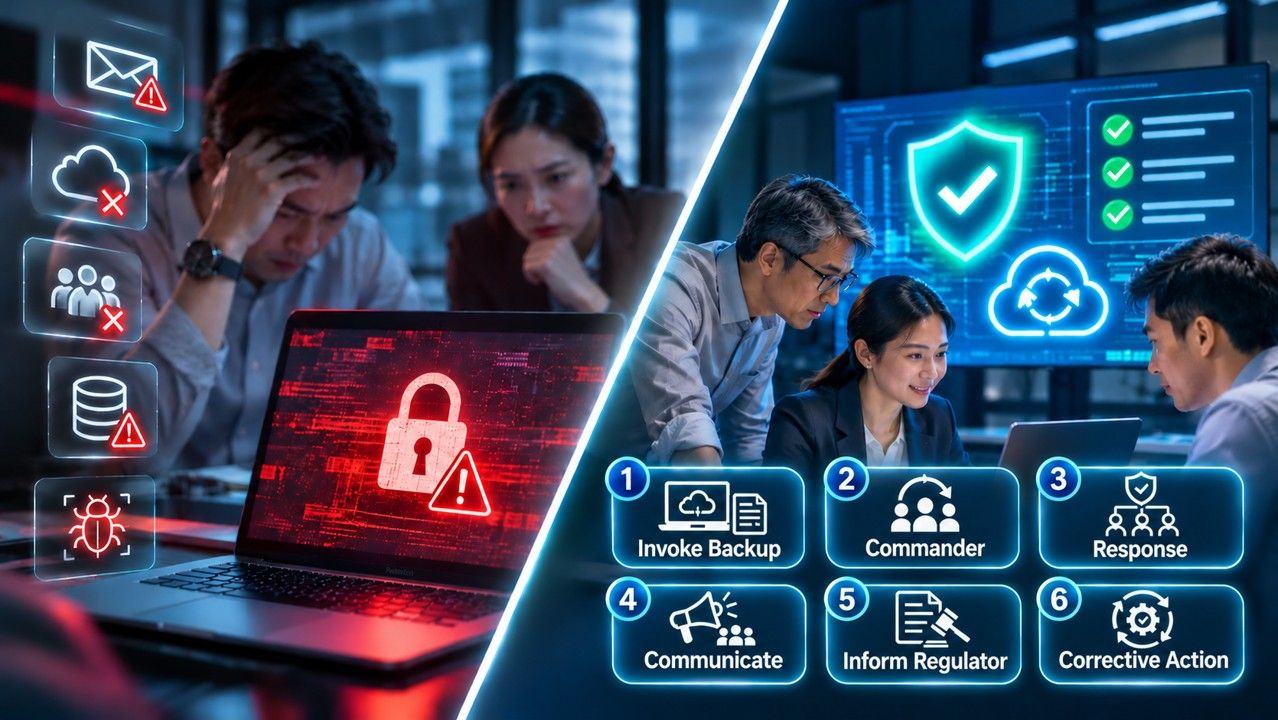
Six Practical Ways to Show Resilience
Have a backup way of working. Decide in advance how your critical services will run if a key system or email is down. It might be paper forms, a shared phone line or a second messaging tool. Write it down and make sure staff know where to find it.
Know who can step in. Identify which services are most urgent and who can be pulled in to cover them. Cross-train a few people so a crisis does not depend on one person.
Set up a response team before you need one. Agree who leads, who investigates, who speaks to management and who handles communications. In a crisis, nobody should be asking whose job it is.
Keep affected customers informed. Tell them what happened, what data was involved and what to watch out for, such as scam calls or phishing emails using their details. Point them to alternative ways to reach you while things are fixed. Dementia Singapore and Our Second Nature both did this, warning customers to be careful with unexpected messages.
Notify the regulator on time and keep them updated. In Singapore, once you assess that a data breach is notifiable, the PDPA requires you to inform the PDPC as soon as practicable and no later than three calendar days. Affected individuals should be told as soon as practicable too. Follow up with progress updates as your investigation develops.
Close the loop after the dust settles. Work out what went wrong, put together a corrective action plan with clear owners and dates, and share it with management. This is also the time to update your fallback plans with what you learned.
Questions To Ask Your Team This Week
- If our main system or email went down tomorrow morning, how would we keep serving customers?
- Who leads our response, and do they know it?
- Which of our vendors hold customer data, and would they tell us quickly if they were breached?
- Do we know how to assess a breach and meet the PDPC's three-day deadline?
None of these need a big budget. They need a conversation, a few decisions and a short document that people can actually find on a bad day.
The best time to plan for a bad day is while it is still a good one.
Sources
Statement on recent cybersecurity incidents in healthcare sector – Ministry of Health
Dementia Singapore's CARA app users' personal data potentially exposed – AsiaOne
M1 says data breach identified and contained – Must Share News
Local clothing brand Our Second Nature hit by data breach – The Straits Times via Yahoo News
Singaporeans frustrated as Microsoft outage drags on – AsiaOne
Massive Microsoft 365 outage disrupts Outlook, Teams, Copilot worldwide – BleepingComputer
Required to notify the PDPC – Personal Data Protection Commission
Your Trusted Partner in Professional Growth and Innovation or Bridging the Gap Between Today’s Capabilities and Tomorrow’s Success
AgilenLite helps financial and technology teams bridge the gap between current capabilities and future success with practical, measurable solutions.
Join 3,000+ professionals who've transformed their skills through our IBF-accredited programmes
Professionals Trained
Through Career Conversion Programmes in IT Security & Cybersecurity
Corporate Professionals
Trained in cybersecurity, fraud risk, AML, and cloud security
Years of Excellence
Delivering cutting-edge training and consulting solutions