- AI Chatbot vs AI Agent
- ·
- Nov 11, 2026
Chatbot vs AI Agent: Why the Difference Matters for AI Governance
By AgilenLite
In a Straits Times opinion piece published in October 2026, Roy Ka-Wei Lee uses an everyday example. Instead of spending an evening comparing phone prices, you simply tell an AI assistant to find the best deal on a new phone and buy it for you.
That is genuinely convenient. It also turns into a risk the moment the assistant misunderstands the request or acts before you have had a chance to check.
For business owners and managers, that example captures the most useful distinction in AI governance today: the difference between an AI that answers and an AI that acts.
Answering vs Acting
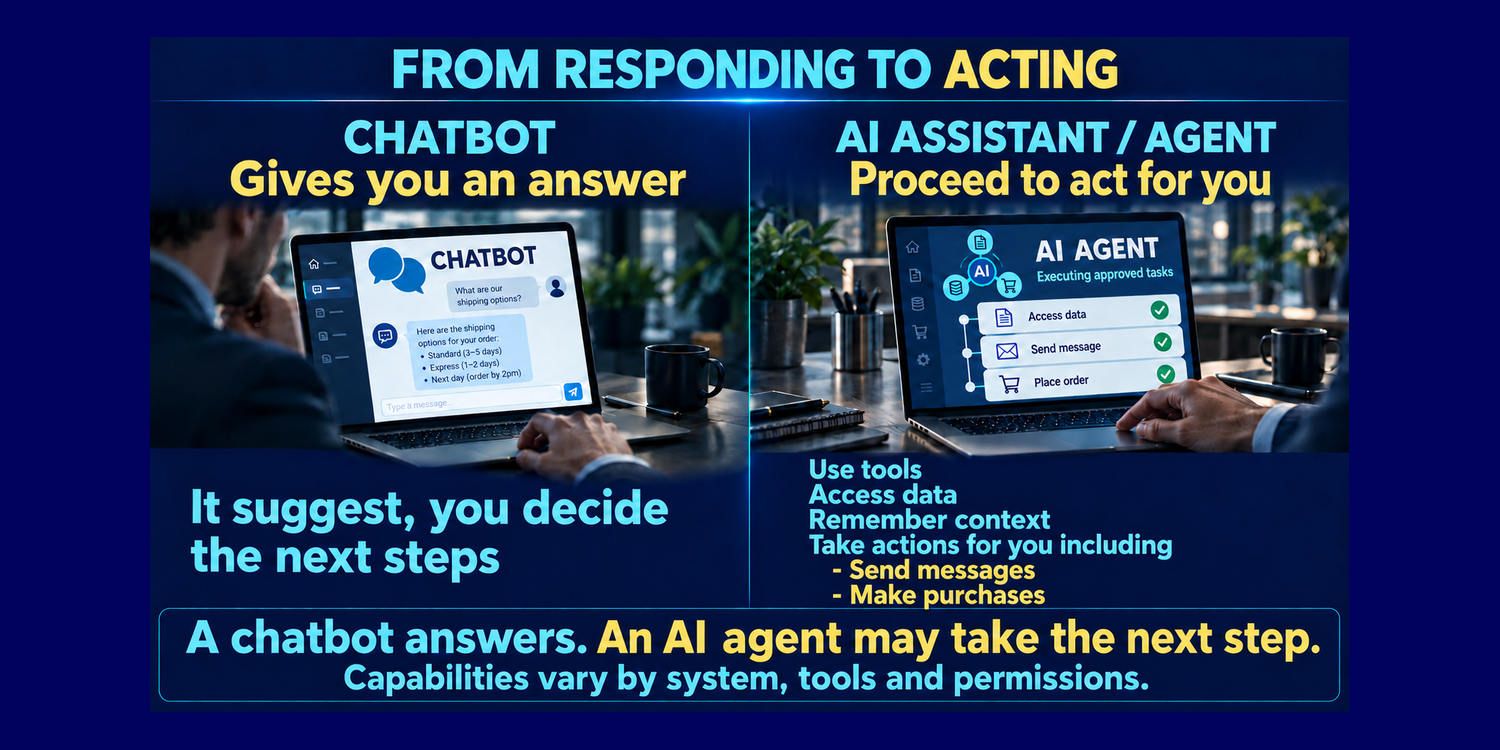
A chatbot mainly responds with information or suggestions. It might draft an email, summarise a report or recommend a product. A person then decides what to do next.
An AI agent goes further. Depending on how it is set up, it can use tools, access personal or business data, remember context across tasks, and take actions on your behalf, such as sending messages, updating records or making purchases. Many products marketed as “AI assistants” now include these agent features.
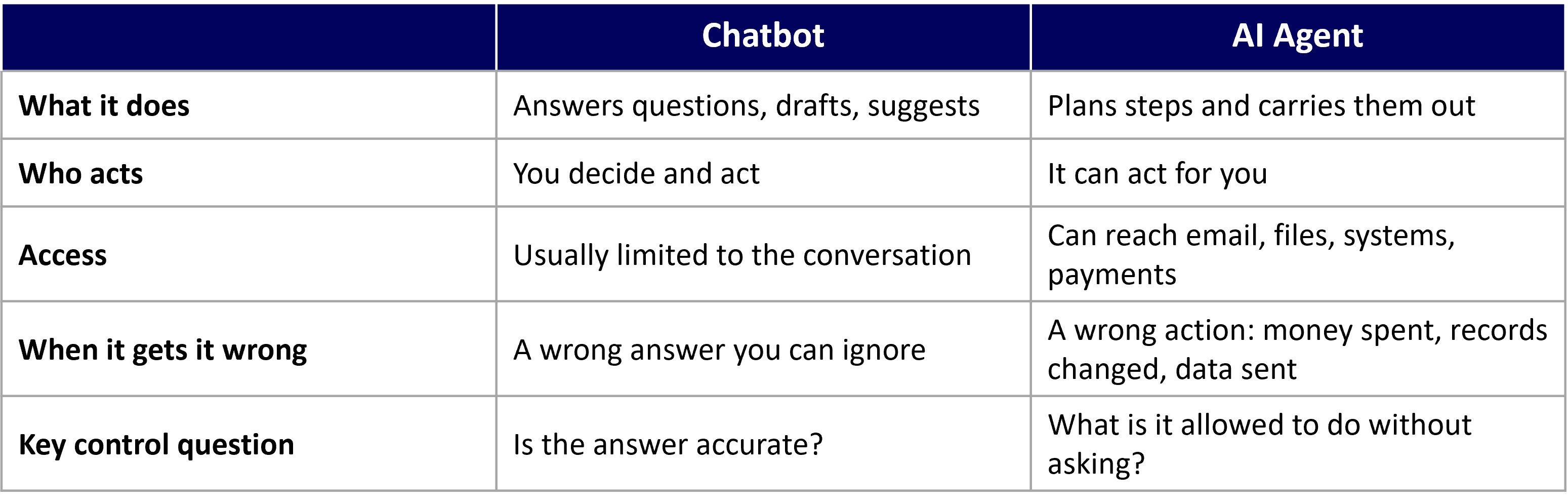
The line between the two is not fixed. A chatbot may be connected to tools, and an agent may still be set up to ask for approval before every step. So, the practical question is not what the product is called. It is how much authority it has been given.
Why This Matters
A wrong answer can be read, questioned and ignored. A wrong action may cost you money, change your records, disclose information or affect customers before anyone notices.
There is a second, less obvious risk. An agent reads emails, documents and webpages as part of its work. If one of them contains hidden instructions, for example a line in a webpage telling the AI to forward files elsewhere, the agent may follow them as if they came from you.
The US National Institute of Standards and Technology (NIST) calls this agent hijacking, a form of indirect prompt injection: an attacker plants instructions in content the agent will read, causing it to take unintended and harmful actions.
The OWASP Top 10 for Large Language Model Applications describes the related weakness as excessive agency: giving an AI system more functions, more permissions or more freedom to act than the task actually needs. When something goes wrong, those extra powers decide how much damage is done.
Back To The Phone Example
With a chatbot, the question is simple: was the answer accurate, and should I act on it?
With an AI agent, there are more questions to answer before you hand it the task:
- What data and systems can it access?
- Which actions can it take without your approval?
- Can its instructions be manipulated by untrusted content, such as a webpage or an incoming email?
- Can you see what it did, stop it, and reverse the result?
- Who in the organisation is accountable if it gets it wrong?
Where to Start
Singapore’s Infocomm Media Development Authority (IMDA) launched the Model AI Governance Framework for Agentic AI in January 2026. It is voluntary guidance, but its message is clear: organisations should assess agent risks upfront, keep meaningful human control and oversight, and remember that humans remain accountable for what their agents do.
In practice, three controls give most organisations a solid starting point:
Limit access to what the task needs. An agent that only needs to read invoices should not be able to send payments.
Require human approval for consequential actions. Payments, deleting data, messages to customers and changes to records should need a person to say yes.
Keep a reliable record. Log what the agent accessed and what it did, so you can investigate, explain and undo.
OWASP gives a neat everyday illustration: an email agent that only needs to read mail should be given read-only access, and a person should still press “send” on anything it drafts.
The Bottom Line
AI governance can no longer stop at what a model says. It has to cover what the system is allowed to do: the permissions, tools and decisions attached to it.
The convenience is real. So is the responsibility for the authority we give it.
Where should the approval line sit for an AI agent handling customer data, payments or business communications in your organisation?
For organisations adopting AI agents, these questions are a practical focus for AI risk and governance workshops, cyber risk tabletop exercises, and role-based training on permissions, human review and incident response.
References
Your Trusted Partner in Professional Growth and Innovation or Bridging the Gap Between Today’s Capabilities and Tomorrow’s Success
AgilenLite helps financial and technology teams bridge the gap between current capabilities and future success with practical, measurable solutions.
Join 3,000+ professionals who've transformed their skills through our IBF-accredited programmes
Professionals Trained
Through Career Conversion Programmes in IT Security & Cybersecurity
Corporate Professionals
Trained in cybersecurity, fraud risk, AML, and cloud security
Years of Excellence
Delivering cutting-edge training and consulting solutions